Arlington, Virginia; December 12th, 2025
The United States Space Force is formalizing how it names and describes its weapon systems, presenting the effort not as a marketing exercise, but as a deliberate step toward building a coherent service identity, shared language, and operational clarity across the force. During remarks delivered at Spacepower 2025, Gen. Chance Saltzman, Chief of Space Operations, outlined a structured approach to naming systems using consistent themes tied to mission sets, emphasizing that words, terminology, and names shape how a military service understands itself and communicates with others.
According to the official Spacepower 2025 transcript published by THE UNITED STATES SPACE FORCE, Gen. Saltzman described themed naming as part of a broader effort to give Guardians a common cultural and operational reference point. He explained that naming conventions are intended to align with what systems do, how they are employed, and how Guardians see their role as warfighters in the space domain, rather than as abstract technical support personnel.
In his remarks, as recorded by THE UNITED STATES SPACE FORCE, Gen. Saltzman referenced several thematic categories that the service has associated with different mission areas. These themes, described verbally rather than through a single consolidated public diagram, include concepts such as “Ghosts,” “Sentinels,” “Sharks,” and “Constellations.” Each theme is intended to evoke particular attributes; stealth, vigilance, pursuit, or presence; and to create intuitive mental associations between a system’s name and its operational role.
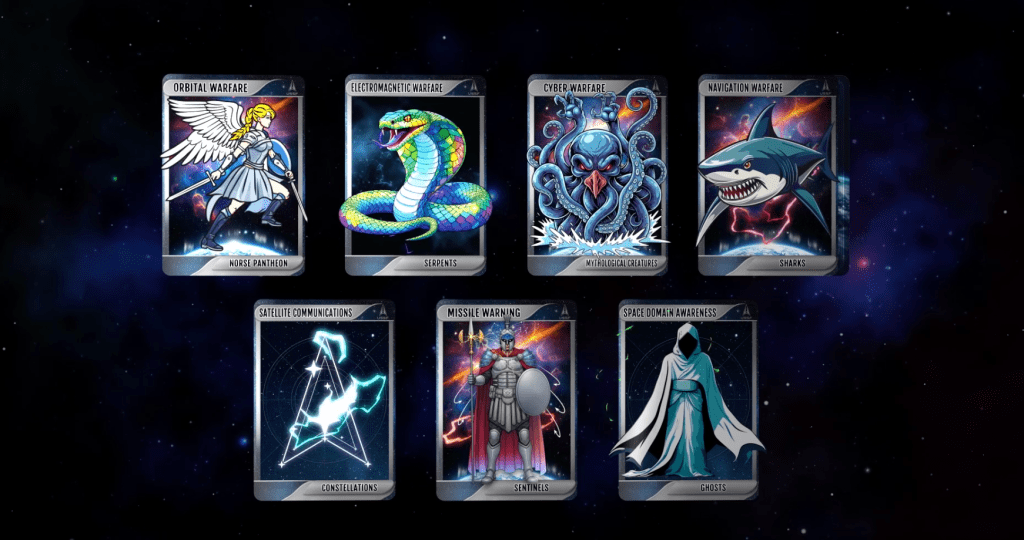
Official U.S. Space Force briefing graphic presented during Spacepower 2025, illustrating themed weapon system naming used to reinforce Guardian identity and mission clarity.
Two specific weapon system names were cited directly in the official record: “Ursa Major” and “Bifrost.” As presented by THE UNITED STATES SPACE FORCE, these names serve as concrete examples of how the service intends to apply its thematic framework. “Ursa Major,” drawn from a prominent constellation, reflects a naming approach that connects space systems to celestial navigation and persistent presence, while “Bifrost,” a mythological bridge, evokes connectivity, linkage, and transition, concepts that align with space-based command, control, and enabling functions.
The Space Force’s own public release following Spacepower 2025, issued by THE UNITED STATES SPACE FORCE, reinforces that these names were not selected in isolation, but are part of a repeatable, governed process. That process is defined in SPACE FORCE INSTRUCTION 16-403, the official directive that establishes how weapon systems are named and designated. The instruction outlines approval authorities, documentation requirements, and the intent to ensure consistency across the service, signaling that naming decisions are institutional, not ad hoc.
Beyond individual system names, service leadership has framed this effort as part of a larger focus on language discipline. In CSO NOTICE TO GUARDIANS C-NOTE #32, “Our Words Have Meaning,” published by THE UNITED STATES SPACE FORCE, leadership emphasizes that terminology, definitions, and naming conventions affect doctrine, training, and interservice coordination. The notice explicitly connects language precision to warfighting effectiveness, arguing that unclear or inconsistent terminology can undermine shared understanding within the Joint Force.
Visually, as described in official materials and supported by the Spacepower transcript published by THE UNITED STATES SPACE FORCE, the concept presented to attendees emphasized grouping and categorization rather than a single branded aesthetic. Themes were described as conceptual lanes rather than decorative labels; each lane intended to house systems with similar missions, allowing Guardians to immediately recognize purpose and role through name alone. While no single publicly released graphic enumerates every theme and system pairing, the verbal descriptions provided establish the framework clearly enough to confirm intent without speculation.
From an institutional standpoint, the Space Force is positioning naming as a tool of cohesion. By standardizing how systems are named, leadership aims to reduce ambiguity, reinforce shared identity, and ensure that when Guardians, joint partners, or civilian leaders hear a system’s name, they can infer function, domain, and purpose without lengthy explanation. This approach mirrors long-standing practices in other military services, while adapting them to the unique operational environment of space.
The verifiable record, as established by THE UNITED STATES SPACE FORCE, shows that themed naming is now a formally acknowledged component of Space Force culture and governance. It is supported by official remarks, official instructions, and official internal guidance, all pointing to the same conclusion: language, in the Space Force’s view, is not cosmetic. It is operational.
Sources
• THE UNITED STATES SPACE FORCE, Transcript of Gen. Chance Saltzman’s Spacepower 2025 Keynote Remarks
• THE UNITED STATES SPACE FORCE, Official Spacepower 2025 Post-Event Release on Weapon System Naming
• THE UNITED STATES SPACE FORCE, SPACE FORCE INSTRUCTION 16-403, “Weapon System Naming and Designation”
• THE UNITED STATES SPACE FORCE, CSO NOTICE TO GUARDIANS C-NOTE #32, “Our Words Have Meaning”


 Appalachian Post
Leave a comment