Pasadena, California; December 16th, 2025
Far above the rust-colored surface of Mars, a camera no larger than a microwave quietly crossed a threshold few instruments ever reach. Without ceremony, without fanfare, and without ever touching the planet it has watched for years, one of NASA’s most important eyes in orbit captured its 100,000th image.
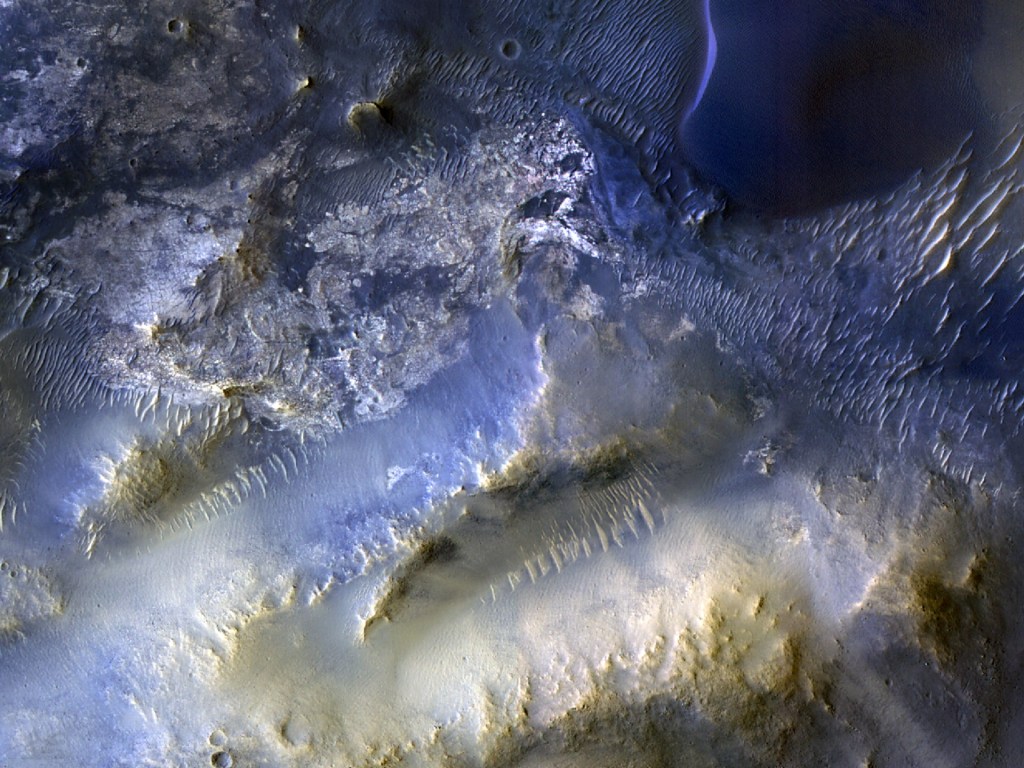
Image captured by NASA’s Mars Reconnaissance Orbiter showing mesas and dunes on Mars, part of the mission’s 100,000th image milestone.
Credit: NASA/JPL-Caltech/University of Arizona
According to THE NATIONAL AERONAUTICS AND SPACE ADMINISTRATION, the Context Camera, known as CTX, aboard NASA’s Mars Reconnaissance Orbiter reached the milestone after more than a decade of nearly continuous observation. Since entering orbit around Mars in 2006, CTX has been steadily building a visual record of the planet, frame by frame, orbit by orbit, revealing the story of a world shaped by time, erosion, and ancient forces.
The image itself is not a portrait meant to impress at first glance. It is a wide view of Mars’ surface, a familiar perspective for a camera designed not to zoom in on fine detail but to provide context, continuity, and scale. That role, NASA explains, is precisely what makes CTX indispensable. While other instruments focus on narrow targets or high-resolution close-ups, CTX connects the dots, allowing scientists to understand how individual features fit into the broader Martian landscape.
NASA states that CTX has become a workhorse for Mars exploration, routinely imaging large swaths of terrain and guiding where more specialized instruments should look next. The camera’s images help scientists track seasonal changes, study surface features shaped by wind and water, and identify sites of interest for future exploration. In many cases, CTX images are the first step in deciding where to aim higher-resolution cameras or where future missions might safely land.
Reaching 100,000 images is not simply a numerical achievement. Each image represents a completed orbit, a precise alignment, and a successful transmission across millions of miles of space. NASA notes that CTX has operated far beyond its original design life, continuing to function reliably in the harsh environment of Mars orbit, where temperature extremes and radiation pose constant challenges.
The Mars Reconnaissance Orbiter itself has been circling the planet for nearly two decades, and CTX has been part of that journey from the beginning. Over the years, the camera has documented everything from towering volcanoes and sprawling canyons to subtle changes in sand dunes and surface streaks that appear and fade with the seasons. These observations have helped scientists piece together Mars’ geological history and better understand the processes that continue to shape the planet today.
NASA emphasizes that CTX’s value lies in its consistency. By imaging the same regions repeatedly over long periods, the camera allows researchers to observe changes that would otherwise go unnoticed. A shifting dune field, a newly exposed layer of rock, or the aftermath of a dust storm becomes visible only when images taken years apart are placed side by side.
The 100,000th image also serves as a reminder of how exploration often advances not through single dramatic moments, but through quiet persistence. CTX does not drill into the ground or roam across the surface. It watches. It records. It builds an archive that grows more valuable with time.
NASA officials note that the camera continues to operate normally and remains an integral part of ongoing Mars science operations. As long as the orbiter remains healthy, CTX will keep adding to its collection, extending the visual history of Mars one image at a time.
Somewhere above the planet, the camera continues its steady work, sweeping across a landscape shaped long before humans ever looked up at the night sky. The milestone has passed, logged in a database and noted by engineers and scientists back on Earth, but the mission goes on.
Mars turns beneath it; the camera keeps watching.
The Appalachian Post is an independent West Virginia news outlet dedicated to clean, verified, first-hand reporting. We do not publish rumors. We do not run speculation. Every fact we present must be supported by original documentation, official statements, or direct evidence. When secondary sources are used, we clearly identify them and never treat them as first-hand confirmation. We avoid loaded language, emotional framing, or accusatory wording, and we do not attack individuals, organizations, or other news outlets. Our role is to report only what can be verified through first-hand sources and allow readers to form their own interpretations. If we cannot confirm a claim using original evidence, we state clearly that we reviewed first-hand sources and could not find documentation confirming it. Our commitment is simple: honest reporting, transparent sourcing, and zero speculation.
Sources
Primary First-Hand Sources
• NATIONAL AERONAUTICS AND SPACE ADMINISTRATION, official release titled “One of NASA’s Key Cameras Orbiting Mars Takes 100,000th Image,” issued December 16th, 2025


 Appalachian Post
Leave a comment